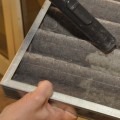
Most filter replacement guides treat pet homes like regular homes — and that's exactly where they go wrong.
A pet home is a different filtration environment entirely. Dogs and cats don't just shed hair. They shed hair coated in dander, dried saliva proteins, and outdoor debris — a biological mix that hits your 12x26x4 filter every hour of every day. We've seen filters from pet households that were fully clogged at 45 days. Filters that a standard six-month schedule would have left running for months longer.
What our experience actually shows:
One pet: replace every 60 to 90 days — not every six months.
Multiple pets or heavy shedders: target 60 days or less.
Allergy or asthma in the home: don't wait for visible signs — change it early and change it often.
This page gives you the full reasoning behind that timeline, the warning signs your filter is already past due, and a replacement habit built around how pet homes actually function — not how filter guides assume they do.
TL;DR Quick Answers
12x26x4 Air Filters
A 12x26x4 air filter is a 4-inch deep residential HVAC filter designed to deliver higher filtration capacity, longer filter life, and superior particle capture compared to standard 1-inch filters of the same face dimensions.
What makes the 12x26x4 format different:
4-inch media depth holds significantly more filtration material than 1-inch filters
Higher MERV capability — runs MERV 11 and MERV 13 ratings without airflow restriction
Longer useful life — greater media volume means more particle-capture capacity before saturation
Whole-home filtration — installed in central HVAC systems to filter air throughout the entire home
Recommended replacement intervals:
Standard household → every 6 months
One pet → every 60 to 90 days
Multiple pets or heavy shedders → every 45 to 60 days
Allergies or asthma present → every 30 to 45 days
Best MERV rating for a 12x26x4:
MERV 11 → baseline for most households
MERV 13 → recommended for pet homes and health-sensitive occupants
Bottom line: The 12x26x4 format is one of the most effective residential filtration options available — especially for pet households — because its 4-inch depth delivers better air quality without the airflow trade-offs that limit thinner, high-MERV filters.
Top Takeaways
Pet homes need a different filter standard — dander, shed hair, and saliva proteins compress filter life far faster than standard schedules account for.
One pet: replace every 60 to 90 days — multiple pets or heavy shedders: every 45 to 60 days — allergies or asthma present: every 30 to 45 days.
Don't trust the visible-dirt test — by the time your filter looks dirty, it's already been working against you for weeks.
MERV 11 is the baseline for most pet homes — MERV 13 when health sensitivity is a factor — the 12x26x4's 4-inch depth handles both without airflow trade-offs.
Build a system, not just a schedule — mark the install date, set a reminder, keep a spare on hand, and treat filter changes as a health habit.
Why Pet Homes Fall Outside Standard Replacement Guidelines
The six-month schedule on filter packaging wasn't calculated for homes with animals — and following it in a pet household is one of the most common air quality mistakes we see.
Pets generate a specific, continuous biological load: dander bonded to shed hair, dried saliva proteins that go airborne during grooming, debris tracked in from outdoors, and odor-producing particles that embed deep into filter media. This doesn't arrive seasonally. It accumulates every hour of every day. From our manufacturing experience, pet-home filters don't just get dirtier faster — they get dirtier in a fundamentally different way, becoming denser and more restrictive to airflow long before they look saturated from the outside.
The Right Replacement Timeline for Your Pet Household
Not every pet home is the same — and the replacement schedule should reflect that.
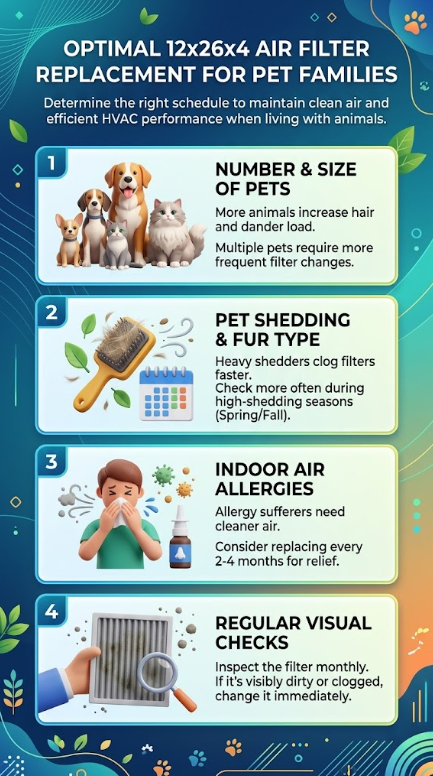
One pet: Replace every 60 to 90 days. Treat 90 days as the outer limit, not the default.
Multiple pets or heavy shedders (German Shepherds, Huskies, Goldens, Maine Coons): Target 45 to 60 days.
Allergy or asthma in the home: Replace every 30 to 45 days — proactively, before visible signs appear.
Warning Signs Your 12x26x4 Is Already Overdue
Filters degrade quietly. These signals appear well before a visual check catches it:
Dust resettling on surfaces faster than usual, even after cleaning
Musty or stale air coming from vents during system cycles
Pet hair collecting visibly at return air vent grilles
HVAC running longer cycles to reach the thermostat set point
Worsening allergy or asthma symptoms indoors
One sign means pay attention. Multiple signs mean it's already past time.
Why MERV Rating Matters More in Pet Homes
The 12x26x4 format's 4-inch depth holds significantly more filter media than a 1-inch filter — meaning you can run a higher MERV rating without the airflow restriction that thinner filters create.
MERV 8: Captures visible pet hair and larger particles. Not sufficient for allergy-sensitive households.
MERV 11: Captures finer dander and smaller allergens. A solid baseline for most pet homes.
MERV 13: Captures particles down to 0.3 microns — including the microscopic dander proteins that most commonly trigger allergic responses. Our recommendation when health sensitivity is a factor.
Simple Habits That Keep Pet-Home Air Consistently Clean
The pet-owning households we hear from with the best indoor air quality share one trait: they've removed the decision from the equation entirely.
Mark the installation date on the filter frame with a permanent marker — 30 seconds of effort, no guesswork later.
Set a calendar reminder the same day you install. Don't trust memory.
Keep a replacement on hand before the current filter expires — not after.
Do a 30-day visual check. Hold it to light. Can't see through it clearly? Change it now.
A replacement schedule that lives only in your head is one that gets pushed. Build it into a system and it runs itself.

"In our experience manufacturing filters for pet households across the country, the homes with the cleanest indoor air aren't the ones that follow the packaging schedule — they're the ones that treat filter replacement as a health habit, not a maintenance chore, and they never wait for a visual cue to tell them it's time."
Essential Resources
We're obsessed with making sure you have everything you need to protect your family's air — not just the right filter, but the right knowledge to use it well. After manufacturing millions of filters and working with pet-owning households across the country, we know the questions that come up before, during, and after a filter decision. These seven resources from the EPA, ASHRAE, CDC, and DOE are the ones we point to most — because informed families make better decisions, and better decisions mean healthier homes.
1. What's Actually Floating Through Your Home — and How Filters Stop It
Source: U.S. Environmental Protection Agency
Most homeowners don't realize how much is moving through their air every day — and this EPA resource makes it visible. It covers how HVAC filters work, which pollutants they capture, and what to look for when choosing between filter options for your specific household.
This is the resource we recommend starting with. It gives you the foundation to understand every other filter decision you'll make.
URL: https://www.epa.gov/indoor-air-quality-iaq/air-cleaners-and-air-filters-home
2. The Guide We Wish Every Pet Owner Would Read Before Buying a Filter
Source: U.S. Environmental Protection Agency
This EPA guide does something most filter packaging doesn't — it explains the difference between MERV ratings in plain language and connects those ratings to real household situations, including homes with pets and family members with allergies or asthma.
In our experience, this is the single most practical government resource for pet-owning families trying to understand what filtration level they actually need.
URL: https://www.epa.gov/indoor-air-quality-iaq/guide-air-cleaners-home
3. HEPA vs. MERV: Understanding What Those Ratings Actually Mean for Your Air
Source: U.S. Environmental Protection Agency
There's a lot of confusion between HEPA and MERV ratings — and that confusion leads families to either overspend or underprotect. This EPA resource clears it up directly. It explains what each rating system measures, and why a high-MERV 4-inch filter like the 12x26x4 can deliver near-HEPA performance without the airflow limitations of a true HEPA system.
Understanding this distinction is one of the most valuable things a pet-household owner can do before selecting a filter.
URL: https://www.epa.gov/indoor-air-quality-iaq/what-hepa-filter
4. The Numbers Behind the MERV Rating — What Each Level Actually Captures
Source: U.S. Environmental Protection Agency
We've seen families choose a MERV 8 because it's what they've always used — not because they've compared it to what a MERV 11 or MERV 13 actually captures. This EPA fact sheet gives you the performance data by rating level, including how much of the smallest, most health-relevant particles each tier removes.
For pet households, those numbers matter more than most filter guides acknowledge.
URL: https://www.epa.gov/sites/default/files/2018-11/documents/indoor_air_filtration_factsheet-508.pdf
5. The Engineering Standard That Every MERV Rating Is Measured Against
Source: ASHRAE (American Society of Heating, Refrigerating and Air-Conditioning Engineers)
When a filter package lists a MERV rating, that number comes from testing methods defined by ASHRAE Standard 52.2. ASHRAE created the MERV system — and this FAQ explains what those tests actually measure and what the ratings guarantee in real-world field conditions.
We reference this standard regularly in our own manufacturing process. It's the authoritative source behind every MERV number in the industry.
URL: https://www.ashrae.org/File%20Library/Technical%20Resources/Technical%20FAQs/TC-02.04-FAQ-61.pdf
6. When Filter Replacement Becomes a Health Decision, Not Just a Maintenance Task
Source: Centers for Disease Control and Prevention
For households where someone has asthma or allergies, keeping dander and allergen concentrations low isn't a comfort preference — it's a health priority. This CDC resource covers pet dander as a direct asthma trigger and outlines the filtration and household management strategies that make a measurable difference.
This is the resource we point to when families tell us they're not sure if a more frequent filter schedule is really necessary. The answer is yes — and here's why.
URL: https://www.cdc.gov/asthma/control/index.html
7. Why a Dirty Filter Costs Your Family More Than Just Air Quality
Source: U.S. Department of Energy — Building Science Education Solution Center
A clogged filter doesn't just circulate dirty air. It forces your HVAC system to work harder, run longer cycles, and wear down faster — costs that show up on your energy bill and eventually in your repair budget. This DOE resource explains the direct relationship between filter maintenance and system efficiency.
In our experience, this is the angle that resonates most with homeowners who aren't yet convinced that timely filter changes are worth the effort. Protecting your air and protecting your HVAC investment turn out to be the same decision.
URL: https://bsesc.energy.gov/energy-basics/hvac-proper-installation-filters
Supporting Statistics
Numbers don't lie — and these three do a better job than any filter packaging ever could of explaining why pet households operate under a completely different set of air quality rules.
Stat 1: The Scale of the Pet-Home Filtration Challenge Has Never Been Greater
"The U.S. dog population reached a new peak of 89.7 million in 2024 — and the cat population has grown to 76.3 million, with the percentage of dog- and cat-owning households increasing steadily since 1991."
— American Veterinary Medical Association (AVMA), 2025 Pet Ownership and Demographic Sourcebook
URL: https://www.avma.org/news/evolving-pet-owner-economics-what-data-reveal-veterinary-teams
What this means for your filter:
More pets in American homes than at any recorded point in history.
Heavier biological load on every residential air filter — every single day.
Standard replacement schedules haven't kept pace with how pet ownership has grown.
From our customer conversations, the pattern is consistent: households reporting allergy symptoms, musty air, and HVAC inefficiency are almost always following a filter schedule written for a home that no longer reflects how most people actually live.
Stat 2: For Tens of Millions of Pet-Owning Families, This Is a Health Decision — Not a Maintenance Task
"Allergies to cats and dogs affect 10 to 20 percent of the world's population — and an asthma episode can begin within 15 to 30 minutes of inhaling pet allergens."
— Asthma and Allergy Foundation of America (AAFA)
URL: https://aafa.org/allergies/types-of-allergies/pet-dog-cat-allergies/
What the overlap between AAFA and AVMA data tells us:
Tens of millions of U.S. households have both pets and allergy- or asthma-sensitive family members.
Pet allergens don't wait for a filter to look dirty before triggering a response.
An asthma episode can begin within 15 to 30 minutes of exposure — filter condition is always a factor.
A filter two weeks overdue in a pet household isn't a minor inconvenience for a sensitive family member. It's an active exposure risk. This is why our recommended replacement interval for health-sensitive pet households starts at 30 to 45 days — not as a precaution, but because the biology demands it.
Stat 3: An Overdue Filter in a Pet Home Quietly Damages Your HVAC System
"A dirty or clogged air filter can dramatically reduce airflow — increasing furnace run time, wear on the motor, and energy consumption."
— U.S. Department of Energy, Building Science Education Solution Center
URL: https://bsesc.energy.gov/energy-basics/hvac-proper-installation-filters
How filter degradation actually works in pet homes:
Airflow drops gradually — not all at once.
Run times stretch. The motor compensates. The energy bill climbs.
Most families notice higher bills before they notice a change in air quality.
Pet hair, dander, and biological debris don't just coat the filter surface — they embed into the media, restricting airflow long before the filter looks ready to be changed. The visible-dirt test fails in pet homes almost every time.
The critical distinction: What you can't see through the filter matters far more than what you can see on it — and by the time airflow restriction becomes noticeable, the HVAC system has already been working harder than it should for weeks.
Final Thoughts
Most filter replacement guides treat pet ownership as a footnote. After manufacturing millions of filters and hearing directly from pet-owning families, we've reached a different conclusion entirely.
A pet home isn't a regular home with an asterisk. It's a fundamentally different indoor air environment — one that generates a continuous, compounding biological load that standard filtration timelines were never designed to address.
What experience has taught us:
The families with the cleanest indoor air aren't the ones with the most expensive filters. They're the ones who change them on time — consistently, without waiting for a visual cue.
The 60-to-90-day guideline isn't conservative. It's the minimum responsible interval for a one-pet household — and the starting point for a shorter conversation when multiple pets or health sensitivity are involved.
A filter that looks fine from the outside has already been silently restricting airflow, recirculating allergens, and straining your HVAC system. The visible-dirt test is one of the most misleading habits in home maintenance — especially in pet homes.
Our honest opinion:
The single most underappreciated thing a pet-owning family can do for their home's air quality costs less than most people spend on pet treats in a month.
Change the filter earlier than you think you need to.
Build it into a system so it happens automatically — not when it's convenient.
Choose the right MERV rating — MERV 11 at minimum, MERV 13 if health sensitivity is a factor — one that matches the biological reality of what your pets release into your air every day.
Clean air in a pet home isn't complicated. But it does require treating the filter schedule as a health habit — not a maintenance chore.
That's the distinction we've watched make the real difference, home after home, year after year.
FAQ on 12x26x4 Air Filters
Q: How often should I replace a 12x26x4 air filter in a home with pets?
A: The six-month schedule on filter packaging was never designed for pet homes. Pet dander, shed hair, saliva proteins, and tracked-in debris accumulate continuously — every hour of every day. Standard schedules don't account for that biological reality.
Replace based on your actual household:
1 pet → every 60 to 90 days
Multiple pets or heavy-shedding breeds → every 45 to 60 days
Allergies or asthma present → every 30 to 45 days, proactively — before visible signs appear
Q: What MERV rating is best for a 12x26x4 air filter in a pet household?
A: Most pet-owning families under-protect themselves by defaulting to the rating they've always bought — rather than matching it to what their household actually generates.
MERV rating guide for pet households:
MERV 8 — captures visible pet hair and larger particles only. Not sufficient for most pet homes.
MERV 11 — captures finer dander and smaller allergens. The baseline we recommend for most pet households.
MERV 13 — captures particles down to 0.3 microns, including the microscopic dander protein fragments that trigger allergic and asthmatic responses. Our recommendation when health sensitivity is a factor.
The advantage most filter guides miss: The 12x26x4's 4-inch media depth lets you run MERV 13 without the airflow restriction that makes high-MERV ratings problematic in 1-inch filters. Better filtration. No airflow trade-off.
Q: Is a 12x26x4 air filter better than a 1-inch filter?
A: For pet households, yes — significantly. The performance gap is one of the most impactful and least discussed upgrades available to pet-owning families.
Why the 4-inch format wins:
Holds dramatically more filter media than a 1-inch filter of the same face dimensions
Greater particle-capture surface area — longer useful life between changes
Supports higher MERV ratings without creating static pressure problems
A 1-inch MERV 13 restricts airflow in many residential systems — a 12x26x4 MERV 13 delivers the same filtration without that penalty
If your HVAC system is designed for a 4-inch filter, using one is a meaningful structural advantage — especially in a home dealing with continuous pet-generated particle load.
Q: How do I know when my 12x26x4 air filter needs to be replaced?
A: Don't rely on the visible-dirt test. In pet homes, it fails almost every time. A filter that looks clean from the outside can already be deeply loaded with fine dander, embedded biological debris, and compacted hair — actively restricting airflow and recirculating allergens.
Watch for these behavioral and mechanical signals instead:
Dust resettling faster than usual after cleaning
Musty or stale air from vents during system cycles
Pet hair accumulating visibly at return air vent grilles
HVAC running longer cycles to reach the thermostat set point
Worsening allergy or asthma symptoms indoors
The system that works:
Mark the installation date on the filter frame with a permanent marker.
Set a calendar reminder the same day you install.
Do a light-check at 30 days — hold the filter up to light. Can't see through it clearly? Change it now.
Q: What does a 12x26x4 air filter actually filter out?
A: Capture capability depends directly on MERV rating. Here's what each level actually does in a pet household context:
The critical distinction: MERV 13 in a 1-inch filter creates airflow problems in many residential HVAC systems. MERV 13 in a 12x26x4 format — with its 4-inch media depth — delivers that same filtration efficiency without the airflow penalty. In a pet home, that's not a technical footnote. It's the difference between a filter that addresses the actual health risk and one that only addresses the visible one.
Ready to Find the Right 12x26x4 Air Filter for Your Pet Household?
Shop our full selection of 12x26x4 air filters in MERV 8, MERV 11, and MERV 13 — and find the filtration level that matches your pets, your family, and your home's actual air quality needs. Don't wait for a visual cue to tell you it's time — get the right filter in place today and start protecting the air your family breathes.
Learn more about HVAC Care from one of our HVAC solutions branches…
Filterbuy HVAC Solutions - Weston FL
2573 Mayfair Lane Weston FL 33327
(754) 296-3528
https://maps.app.goo.gl/E3tjmKf5VSWYghGc7